

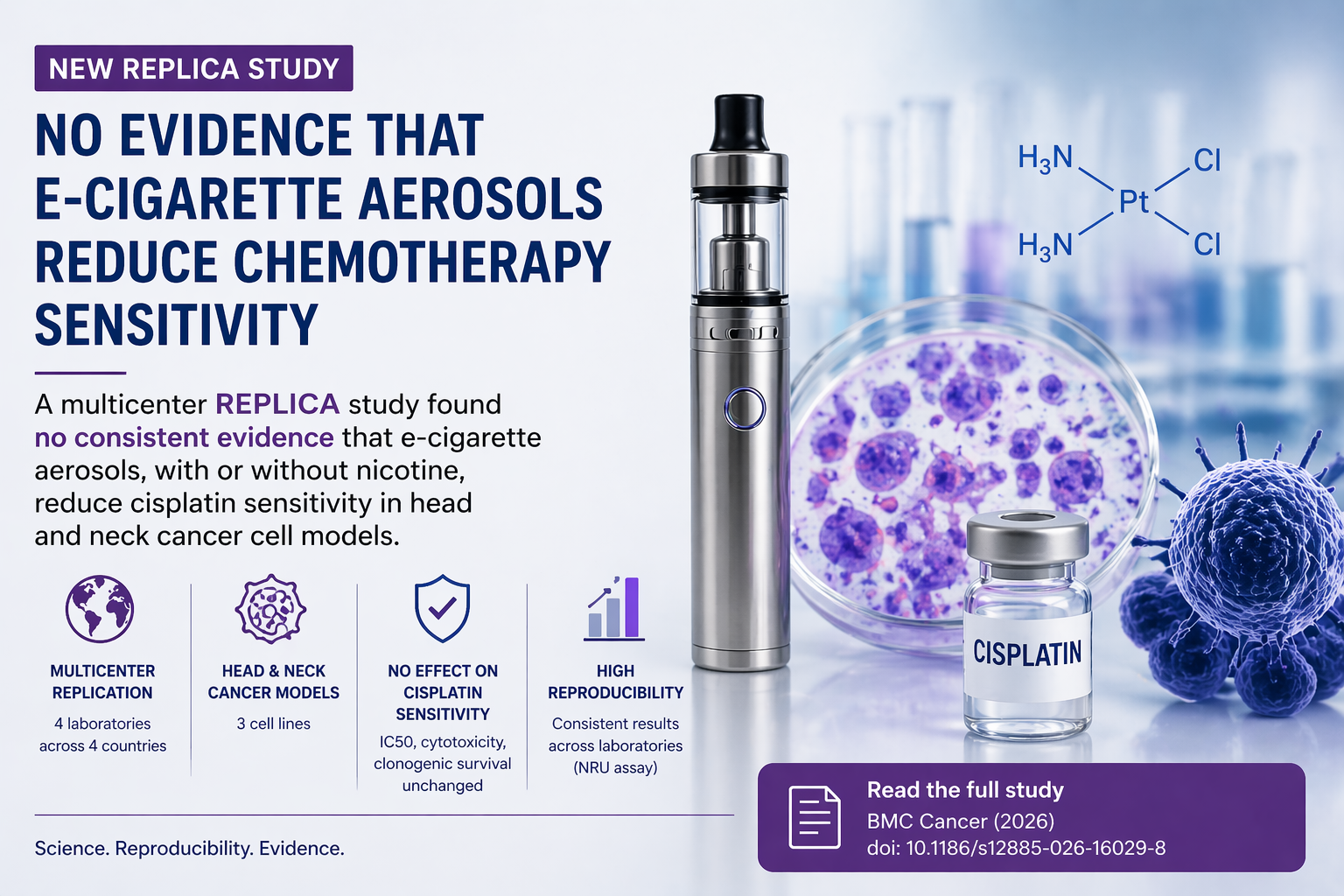
A multicenter replication study conducted by CoEHAR researchers, under the Replica project, reports no consistent evidence that e-cigarette aerosols reduce chemotherapy sensitivity in laboratory models of head and neck cancer.
CoEHAR latest replication study revisits a high-profile concern in cancer research: the possibility that exposure to e-cigarette aerosols may make head and neck cancer cells more resistant to treatment with cisplatin, one of the most commonly used chemotherapeutic agents for these tumors. In a collaborative study published in BMC Cancer, researchers found no consistent evidence that e-cigarette aerosols, with or without nicotine, increased cisplatin resistance in head and neck squamous cell carcinoma models.
The study was specifically designed to re-examine earlier findings suggesting that e-cigarette exposure could reduce the effectiveness of cisplatin. However, under standardized and harmonized experimental conditions across multiple international laboratories, the researchers observed that this effect was not reproducible. Across three cancer cell lines, exposure to e-cigarette aerosols did not significantly alter cisplatin sensitivity, and key measures such as IC50, cytotoxicity, and clonogenic survival remained largely unchanged.
Beyond its biological findings, the study also highlights the importance of scientific reproducibility. The research team implemented harmonized standard operating procedures (SOPs), standardized smoking and vaping machines, and multiple complementary assays across laboratories in Italy, the United States, Indonesia, and Serbia. This coordinated approach enabled a rigorous assessment of whether previously reported results could be replicated under controlled conditions.
The main conclusion was clear: exposure to e-cigarette aerosols did not significantly modulate cisplatin sensitivity in the tested cell lines. Earlier claims that such exposure increases cisplatin resistance were not supported under these experimental conditions. Importantly, no strong nicotine-specific effect was observed, as both nicotine-containing and nicotine-free aerosol extracts produced comparable outcomes.
The study further strengthens its findings by demonstrating high reproducibility of chemosensitivity results across four laboratories, particularly using the NRU assay. While these results challenge earlier reports, they do not exclude the possibility of context-dependent effects and underscore the need for further research in more complex biological systems.
As discussions around nicotine use and cancer care continue, this study serves as a reminder that replication and methodological rigor are essential, especially when addressing questions with potential clinical implications.
As explained by Prof. Giovanni Li Volti, Principal Investigator of the REPLICA project:
Our multicenter replication study shows that e-cigarette aerosols, with and without nicotine, did not increase cisplatin resistance in head and neck cancer cell models, challenging earlier findings and highlighting the importance of standardized, reproducible research.
The REPLICA Project: raising the bar for reproducibility
The REPLICA project was specifically designed to address one of the most pressing challenges in biomedical research: the reproducibility of experimental findings.
By coordinating multi-center conceptual replications of influential studies, REPLICA aims to verify whether previously reported results can be confirmed under standardized and transparent experimental conditions. This approach is particularly relevant in the field of e-cigarette research, where differences in exposure systems, laboratory protocols, and analytical methods can significantly affect outcomes.
Reference
Emma R, Carota G, Partsinevelos K, Rust S, Sun A, Giordano A, Volarevic V, Lesmana R, Goenawan H, Barliana MI, Arsenijevic A, Kastratovic N, Spasic B, Giardina C, Cantali M, Pittalà A, Saab MW, Amorini AM, Polosa R, Caruso M, Li Volti G. Effect of electronic cigarette aerosols on cisplatin resistance in head and neck cancer cells: a collaborative replication study. BMC Cancer (2026). https://doi.org/10.1186/s12885-026-16029-8